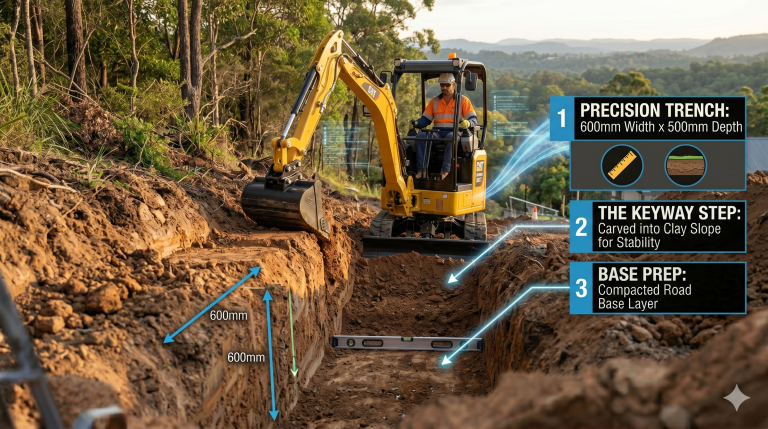
How deep should I dig footings for a retaining wall? For most residential walls under 1 meter, your trench should be at least 600mm wide and 300mm to 500mm deep. Use a 450mm or 600mm bucket on your mini excavator to ensure you have enough space for both the base material (road base or concrete) and the first course of blocks.
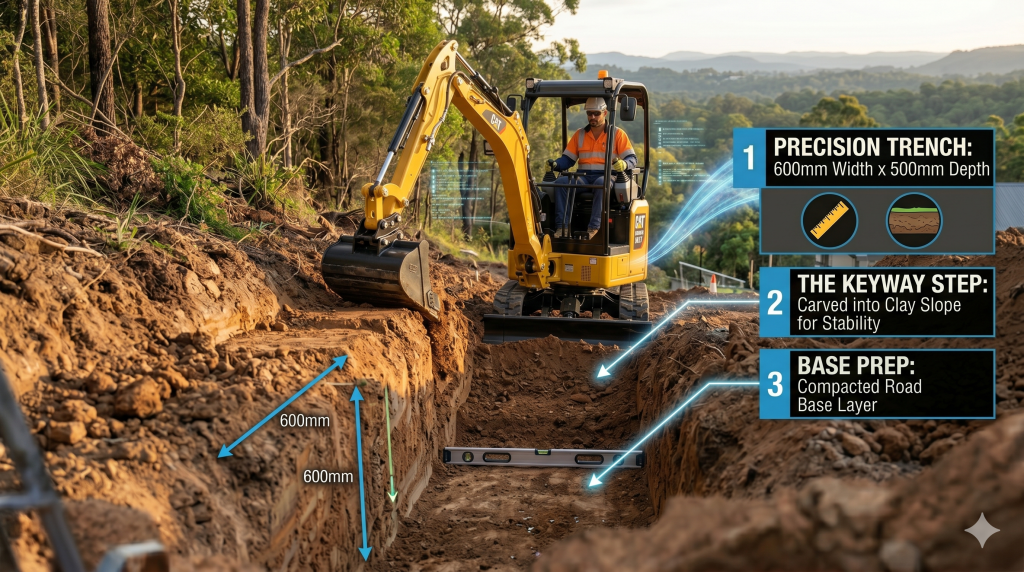
The Anatomy of a Perfect Trench
A retaining wall is only as good as the ground it sits on. On the Gold Coast, soil “heave” (movement) is a major cause of wall failure.
- Setting the Level: Use a laser level. “Eyeballing it” leads to a leaning wall. Your mini excavator’s blade can be used to “pre-level” the area before you start the actual trenching.
- The “Keyway”: If you are building on a slope, you must “key” the wall into the hill. This means digging the trench in a series of “steps.” A mini excavator makes this easy, as you can carve out precise vertical “risers” for each step.
- Compaction and Drainage: Once the trench is dug, don’t just throw in the blocks. You need 100mm of compacted road base. More importantly, you must dig a “drainage channel” behind where the wall will sit. This is where you’ll place your Ag-pipe and 20mm gravel.
Common Mistake:
Many DIYers dig the trench too narrowly. Remember, you need space for the block plus the gravel drainage layer behind it. If your block is 200mm wide, your trench should be at least 400mm-500mm wide to accommodate the drainage zone.