Should I choose Wet Hire or Dry Hire for my excavation? Choose Dry Hire (machine only) if you have an operator’s ticket, experience with tight-access maneuvering, and a strict budget. Choose Wet Hire (machine + operator) if your project involves complex underground services, steep slopes, or if you need the job finished in half the time with professional precision.
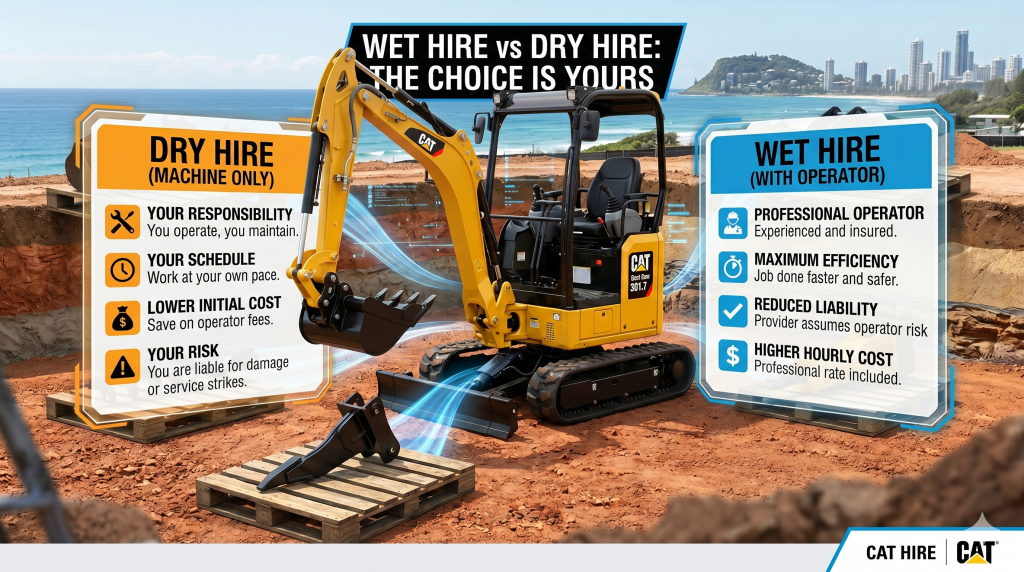
The 2026 Cost-Benefit Analysis
In the current Gold Coast market, the gap between Wet and Dry hire has narrowed due to rising insurance premiums for DIY operators.
- Dry Hire: You are the captain. This is ideal for long-term landscaping projects where the machine might sit idle for hours while you lay sleepers or pipes. You control the pace, but you also hold the liability. If you “throw a track” or hit a pipe, the repair costs and downtime are on your tab.
- Wet Hire: You are paying for a result, not just a machine. A professional operator brings “site eyes”—the ability to sense a pipe before hitting it and the skill to grade a surface to within 10mm of accuracy without a laser level.
The “Invisible” Costs
When calculating your budget, remember that Dry Hire often requires you to provide a vehicle with a 3–tonne to 5–tonne towing capacity for medium-scale projects. If you don’t own a heavy-duty ute, the delivery fees (often $150+ each way) can quickly erase the savings of a Dry Hire agreement. For high-stakes jobs near house foundations, the “peace of mind” of a Wet Hire operator’s insurance is usually worth the extra $50 per hour.