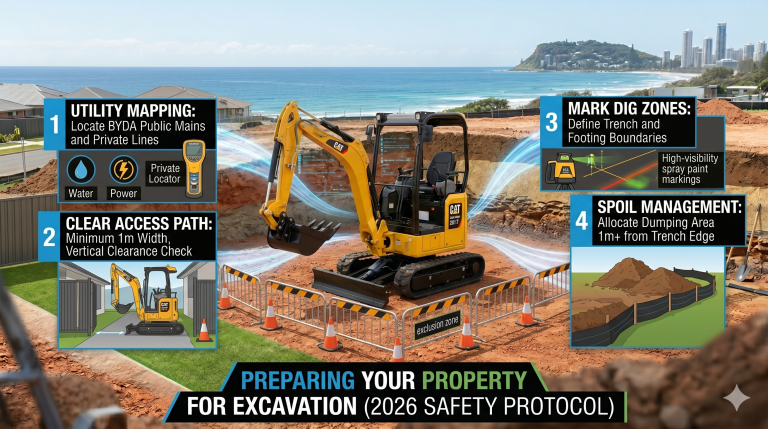
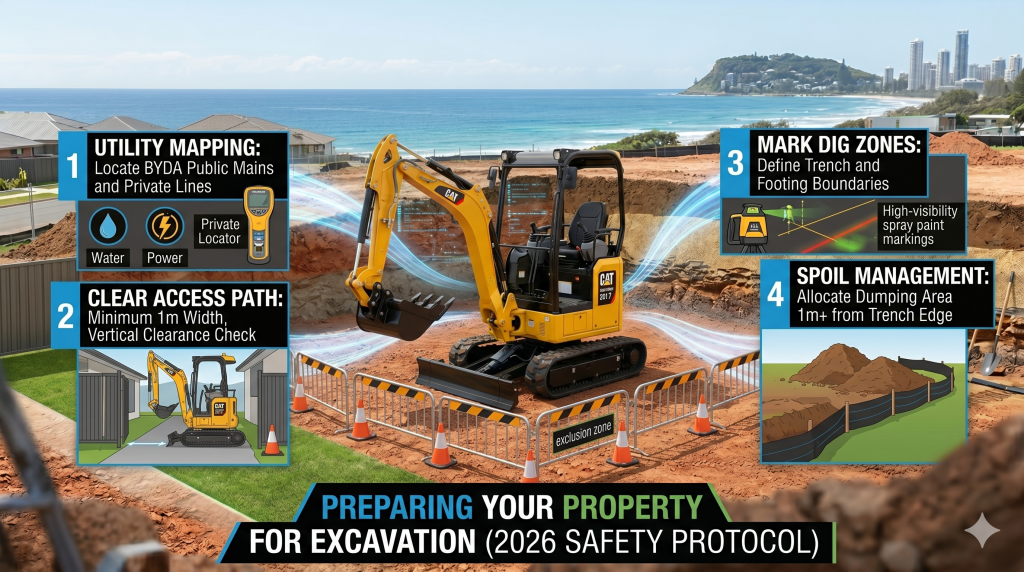
How do I prepare my site for a mini excavator? Preparation involves three critical steps: identifying underground utilities via Before You Dig Australia (BYDA), clearing a minimum 1-meter-wide access path for the machine, and marking your “dig zones” with high-visibility spray paint.
Setting the Stage for Success
Excavation is the “messy” phase of construction, but the more organized your site is, the faster the machine can work. In 2026, local Gold Coast councils tightened regulations regarding sediment control.
- Utility Mapping: Never rely on “memory.” Before You Dig Australia (BYDA) is a free service, but for high-risk sites, hiring a private ground-penetrating radar (GPR) locator is best practice. This is especially true in older suburbs like Southport, where “ghost pipes” (unmapped lines) are common.
- Access and Egress: A 1.7t mini excavator is roughly 990mm wide with its tracks retracted. However, you need “elbow room.” Ensure there are no low-hanging gutters, AC units, or delicate garden walls that could be clipped.
- Spoil Management: Where is the dirt going? A single cubic meter of soil can weigh 1.6 tonnes. If you aren’t keeping the soil on-site, you need a “tip site” and a truck. If you are keeping it, ensure the “spoil pile” is at least 900mm away from the edge of the trench to prevent cave-ins.
The “Neighbor” Factor:
Excavation is loud. Notifying neighbors 48 hours in advance isn’t just polite; it prevents complaints to the council that can lead to “stop-work” orders.